Who we are
Alalay sa Pamilya at Bayan Foundation, Inc. (APBF) is a non-stock, non-profit organization in the Philippines dedicated to grassroots values formation, family enrichment, and youth development.
Operating primarily in collaboration with public schools across the Department of Education (DepEd) and academic institutions such as the University of Asia and the Pacific (UA&P), APBF focuses on strengthening the moral fabric and civic responsibility of Filipino youth, educators, and families.
Core Identity: Alalay sa Pamilya at Bayan Foundation, Inc. (APBF)
Core Focus: Moral recovery, character development, and family-centered nation-building.
Operating Model: APBF does not operate as a commercial entity or financial charity; instead, it provides structured programs, school modules, educator training, and community sports initiatives directly to public school campuses.
Key Vehicles:
CACHET (character education, mentoring, and student clubs).
Grassroots Futsal & Character Sports (using team sports to build discipline, humility, and sportsmanship).
Teacher-Coach Formation (training guidance counselors and physical education teachers to serve as life mentors).
What is CACHET?
CACHET stands for Campaign for Character Education Tenacity. It is APBF’s flagship values-formation and youth leadership program.
Rather than treating character education as an abstract academic subject, CACHET translates virtue into practical, daily habits through structured campus engagement.
1. The Core Philosophy
CACHET guides students through three progressive stages of personal development:
Self-Knowledge: Understanding one’s dignity, strengths, weaknesses, and conscience.
Self-Mastery: Practicing emotional discipline, temperance, and resistance to negative peer influence.
Self-Giving: Directing one's talents toward the service of family, school, and country.
2. On-Campus CACHET Clubs
APBF works with public elementary, junior high, and senior high schools to establish CACHET Associate School Clubs.
These clubs are run by student-officers who model positive character traits and organize campus-wide activities, promoting positive peer influence.
3. Targeted Youth Workshops
CACHET conducts age-appropriate forums and workshops covering real-life student dilemmas:
Home & Family Life: Fostering respect, communication, and obedience at home.
Academic Diligence: Developing tenacity and a serious work ethic in studies.
Social Media & Peer Pressure: Responsible digital citizenship and emotional resilience.
Relationships & Boundaries: Mature self-respect, integrity, and healthy peer friendships.
4. Alignment with National Values & The "Three R's"
CACHET integrates the Department of Education's core values:
Maka-Diyos (Love of God / Human Dignity)
Makatao (Compassion and Solidarity)
Makakalikasan (Stewardship of the Environment)
Makabansa (Patriotism and Civic Duty)
All activities emphasize the Three R's: Respect, Regard, and Responsibility.
5. The Saxum Recognition
Named after the Latin word for rock (Saxum), this is APBF's annual recognition initiative that honors resilient student-leaders, exemplary teacher-mentors, and benchmark schools that maintain steadfast moral integrity in their communities.
Vision:
A revival of the moral and cultural values of the Filipino people, inspiring all to become enlightened, fulfilled members of society dedicated to the common good..
Mission:
To assist schools and communities through the CACHET (Campaign for Character Education Tenacity) Program.
To nurture individuals who become happy, enlightened, and contributing members of society.
To offer volunteers the opportunity to embrace the joy and meaningful challenges of volunteerism in nation-building.
To collaborate and build networks with entities sharing the same vision for development.
Values:
CACHET’S TRIPOD OF HUMAN QUALITIES
RESPECT – We honor ourselves, every person around us. We value each individual and care for everyone’s well-being — no matter their beliefs, background, or situation.
REGARD — We show genuine care and concern. We protect others’ reputations and stand up for their welfare.
RESPONSIBILITY — We commit to the true good of the other, with corresponding acts of genuine charity, having the highest of motives
Goals:
To promote the development of moral and spiritual values and attitudes of children and adults in order to preserve the traditional values of Filipino family and strengthen its solidarity and stability as the basic unit of society; by teaching CAMPAIGN FOR CHARACTER EDUCATION TENACITY to the students, teachers and parents of public schools nationwide; by conducting mentoring sessions, values and parenting seminars to parents and teachers to improve family bonding and child upbringing. (Reference: Article 2 : No. 5 As amended last Nov. 24, 2025)

THE GALLEON SHIP AND THE BOAT
The heraldry of the University of Asia and the Pacific is a galleon ship … it was this vessel that would sail from Europe to the Americas via the Philippine Islands during the Spanish Colonial Period. It represents the University’s aim “to be a bridge of mutual understanding and cooperation between Asia and the rest of the world.”
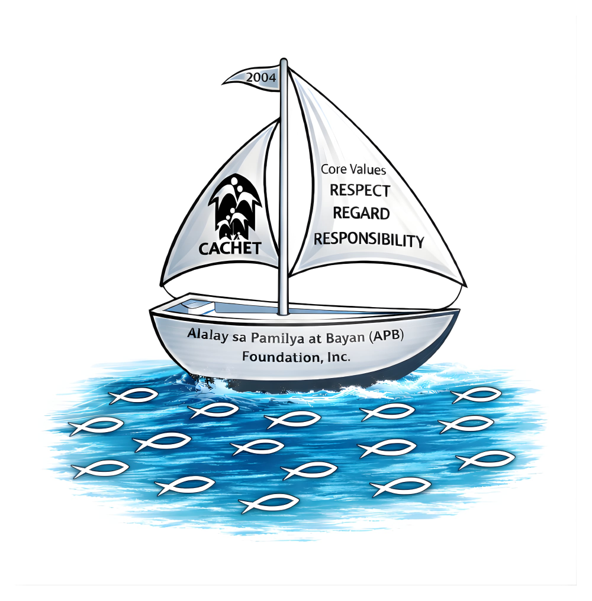
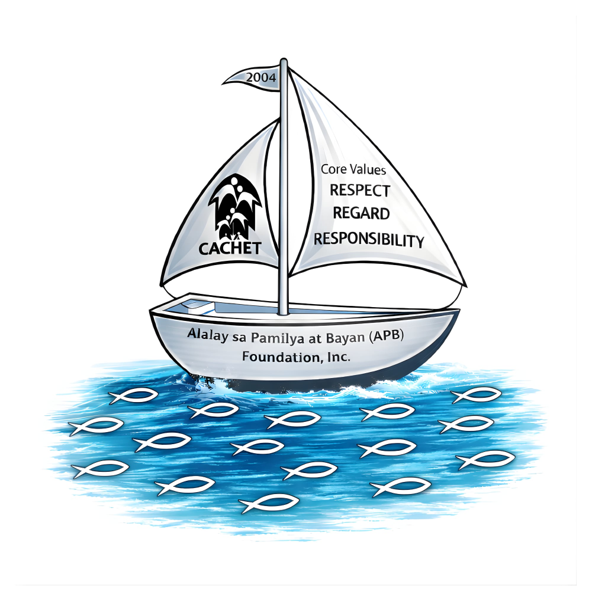
On the other hand, the logo of Campaign for Character Education Tenacity (Cachet) program is a ferryboat (lantsa in Tagalog) that comes out of a big ship to reach the smallest ports and piers where the galleon ship could not reach because of shallow waters.
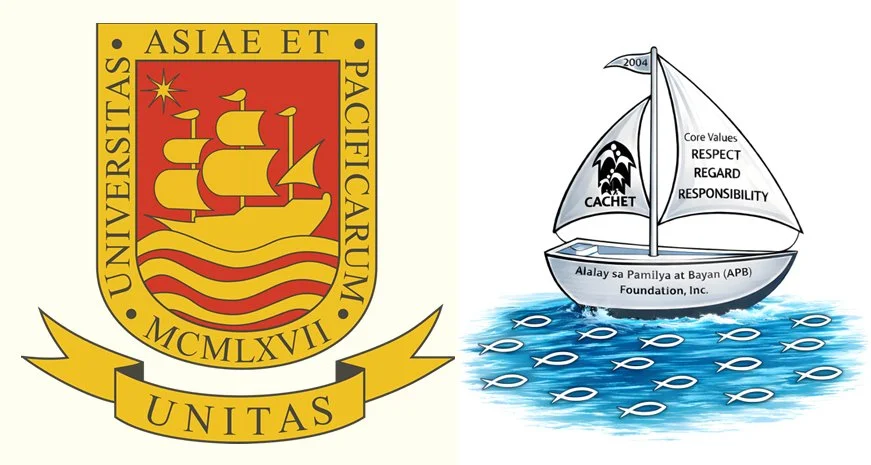
It is the two vessels that aim and attempt to spread the campaign for character education tenacity to as many schools, towns, cities, provinces, and regions of the Philippines through a partnership that should last forever in time through succeeding generations of Filipinos. Ójala! Sana! Harinawâ!
In a ship, there are four sets of personnel:
The People behind the Helm ;
The Men and Women on Deck (the sailors)
The Men and Women below Deck (the engineers)
The Shipbuilders.

THE MEN AND WOMEN ON DECK
They are the Cachet Support Group (CSG), comprising
the adult and peer Mentors
the Technical Working Group (TWG),
the Cachet Organizing Team (COT).
The group membership includes teacher-coaches, select Cachet alumni, and well-trained Cachet Senior and even Junior High School officers. The Bridge of the ship is its nerve center. “From this area, the ship is navigated, maneuvered and operated to accomplish the goals of the cruise safely and effectively. Paraphrasing this usage for our purposes, the Cachet Support Group works closely with the three major officers of Cachet … emcees; opening prayer; ensuring the program flow, manning the full technology board; doing one on one mentoring of everyone in the program; crafting videos, ensuring material order … everything. Under the baton of the Executive Director (the ship's purser).
Yes, the Cachet Support Group is the nerve center of the program on the whole and in each event. That is why the “select candidates” are trained and formed well on-site, not only on technical skills, but most especially, on morals and proper personal and social conduct. They are also mentored by older ones and those who are undergoing continuing formation on the teachings on education, morals, and norms of life of St. Josemaría Escrivá, the inspiration behind Cachet.
What is perhaps most significant behind the existence of CSG is that it becomes a formidable development ground for post Cachet life. Indeed, many of the past student leaders in Cachet's 20 years are already in college or in their starting, even advanced, professions. They are no longer present in Cachet events, but their testimonies of gratitude are most heart-warming … on mentoring, on performing organizational tasks, on being corrected for mistakes or acts of irresponsibility, on pats on the back during down moments, on warm hellos …
The details of their memories have faded, but their STERLING CHARACTER is embedded in the minds and hearts of those who have been in Cachet for many years now.
THE PEOPLE BEHIND THE HELM
There are three major ranks in a ship, paraphrased for our purposes: the Captain (handler of the ship), the Purser (in charge of operations), and the Helmsman (in charge of direction).
From the start of Cachet in 1995,
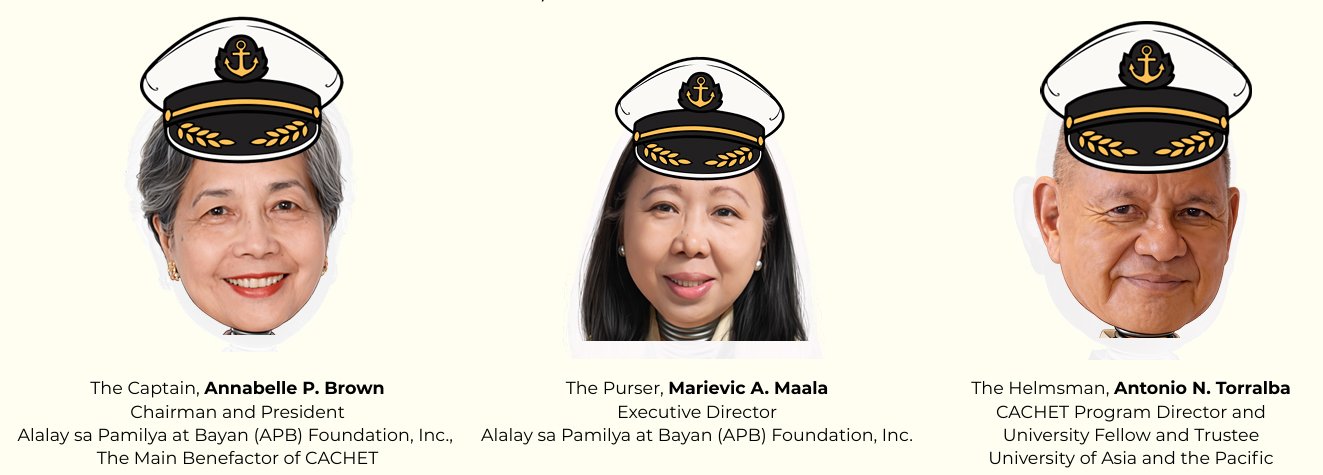
TOGETHER, THE THREE HAVE COMPRISED THE EXECUTIVE COMMITTEE OF CACHET, A COLLEGIAL BODY DECIDING ON THE PROGRAM'S MAJOR THRUST, ACTIVITIES, PROJECTS, AND KEY PERSONNEL
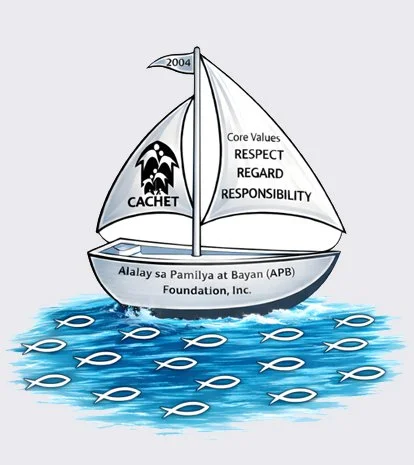
The ship’s Helm is Alalay sa Pamilya at Bayan (APB) Foundation, Inc. It steers the vessel to control the direction of the ship.

The ship’s Rudder is University of Asia and the Pacific. It is a primary control surface underneath the rear end of the ship, steering it in sea waters.

THE MEN AND WOMEN ON DECK
In a ship “below deck” many times refers to the lowest decks, where the engine room is located, usually found at the rear of the ship, near the bottom, to maintain balance. Everything that runs the ship is located in this area, under the direct responsibility of engineers. They are the least seen, the least known, the men and women behind- and beside-the-scene.
Again, paraphrasing this ship structure for our purposes, the engineers in Cachet events, especially those held in University of Asia and the Pacific, where participants can number between 500 and 700, would include
the Information Communication Center
the Set-up personnel: furniture, sound system, visuals
the Maintenance Personnel
the Security Guards and
the Cafeteria cooks and food service personnel.
They are the men and women who ensure the smooth material flow of the event …
setting up the place according to specifications
Keeping the place clean, according to UA&P standards
ensuring everything about the sound and visual system
Showing a most cordial welcome, complete with sincere smiles
Of course, there are foul-ups, but more and more these had become few and far between.
The most significant element behind the men below the deck is that they are the more valuable type of personnel in any institution. They make teaching and learning possible … smooth.
Cachet never tires of its effort to show appreciation to these least noticed. In several instances, they have received medals and plaques of recognition, which they in turn display with some pride in their offices and homes.
Board of Trustees
Annabelle Pizarro Brown
President
Patricia Anne Brown Juat
Vice President
John Walter Brown Juat
Public Information Officer
Joseph Vincent Del Moral Marfori
Corporate Secretary
Maria Clara Malazarte Sibulo
Chief Financial Officer
Our Management
Donnamarievic A. De Maala
Executive Director
Antonio N. Torralba
Program Director
Contact us
Interested in working together? Fill out some info and we will be in touch shortly. We can’t wait to hear from you!